 Hazardous Area Sites
Know every hazardous-area site in your region — who runs it, and how many people work there.
Refineries, platforms, terminals, chemical and pharma plants. One map, every figure sourced.
Sign up — free No card. A person approves each account, usually within a day.Made for people whose work touches these sites.
Analysts and investors
See capacity and exposure by region, operator or asset class. The data comes from an independent register, not a company's own filing.
Insurers and underwriters
Check what a facility is, what it handles and its hazardous-area status before you price risk. Every fact shows its source.
Suppliers, EPCs and service firms
Size a territory before you staff it. Draw a box on the map and read off sites and field workers.
Safety teams, researchers, journalists
Benchmark sites, follow closures and expansions, check claims. This is where the hazardous zones and the people are.
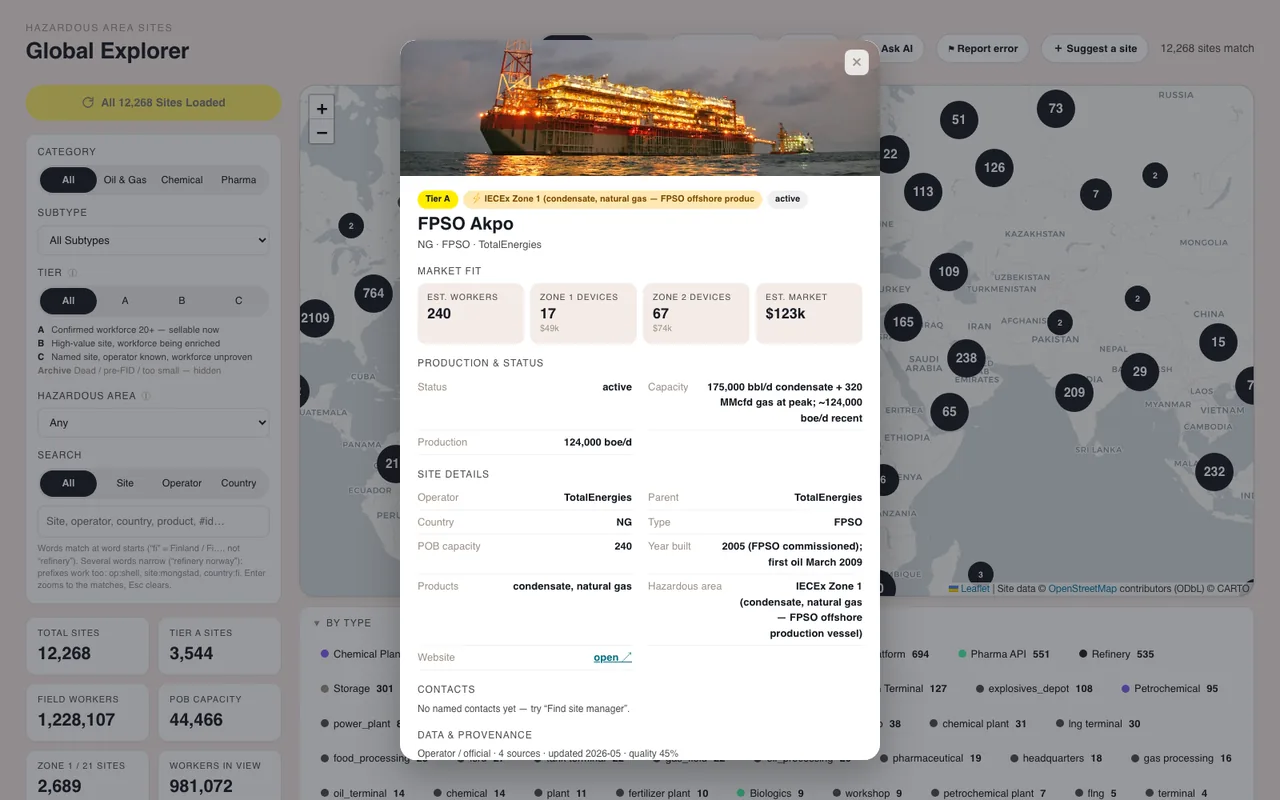
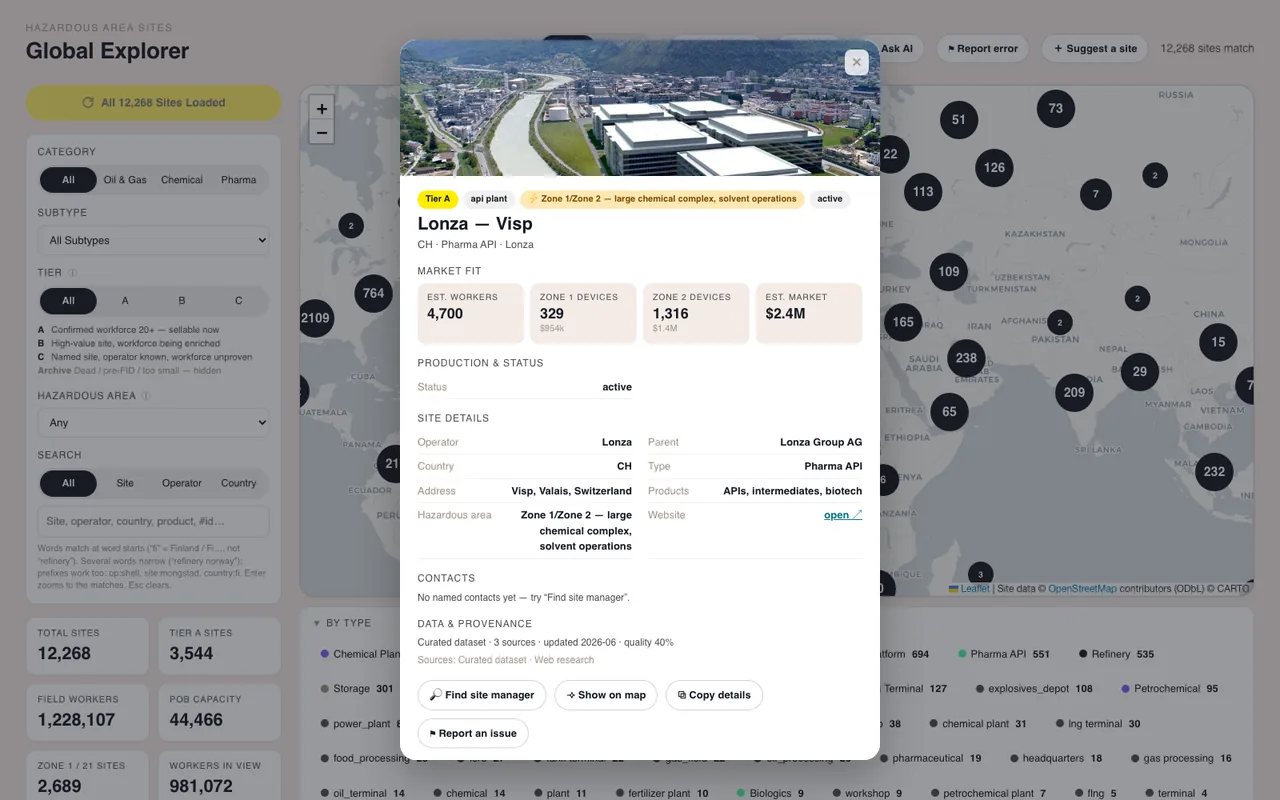
Every marker is a real site with a record behind it.
Operator, type, workforce, photo and hazardous-area classification. Click a pin and read the record. Where a figure is unknown, it says so. Nothing is filled in with zeros.
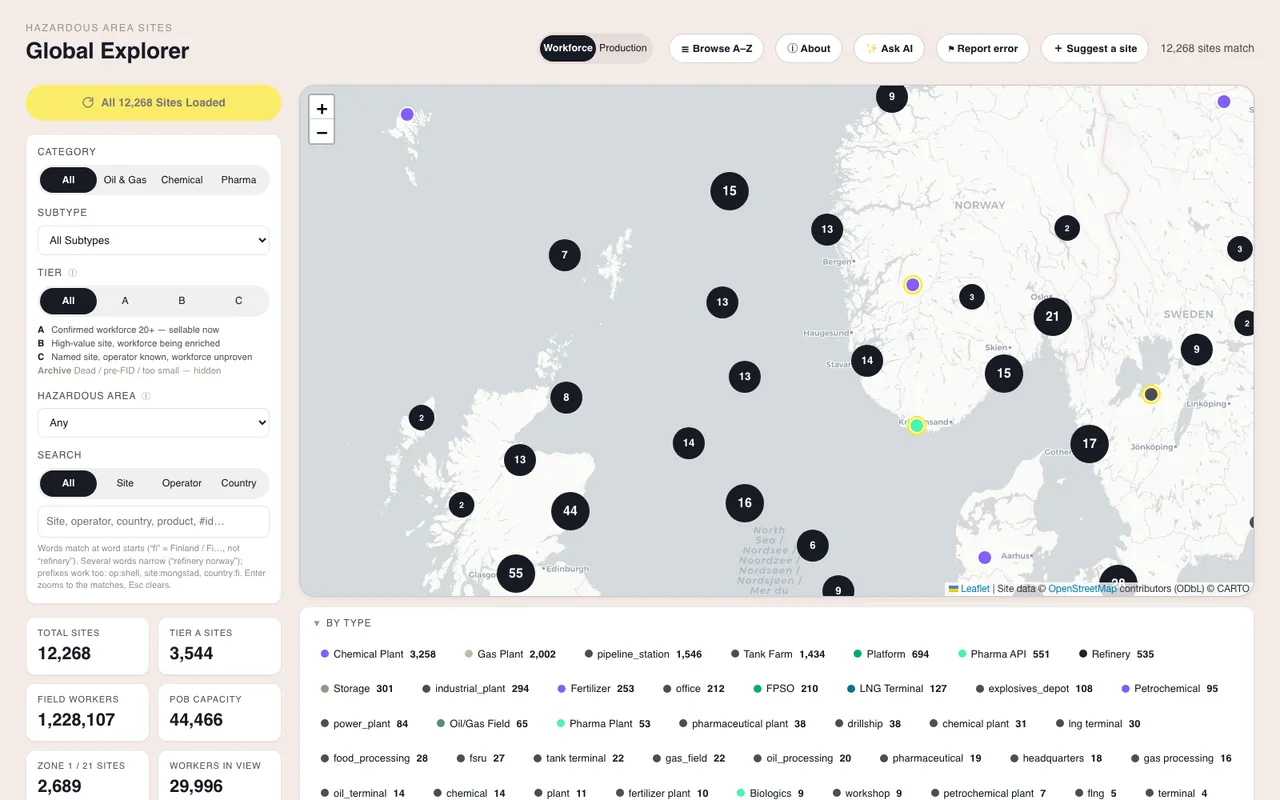
Size a market by drawing a box.
Drag over any region. The explorer adds up sites and field workers as you go. Filter by category, tier or hazard status.
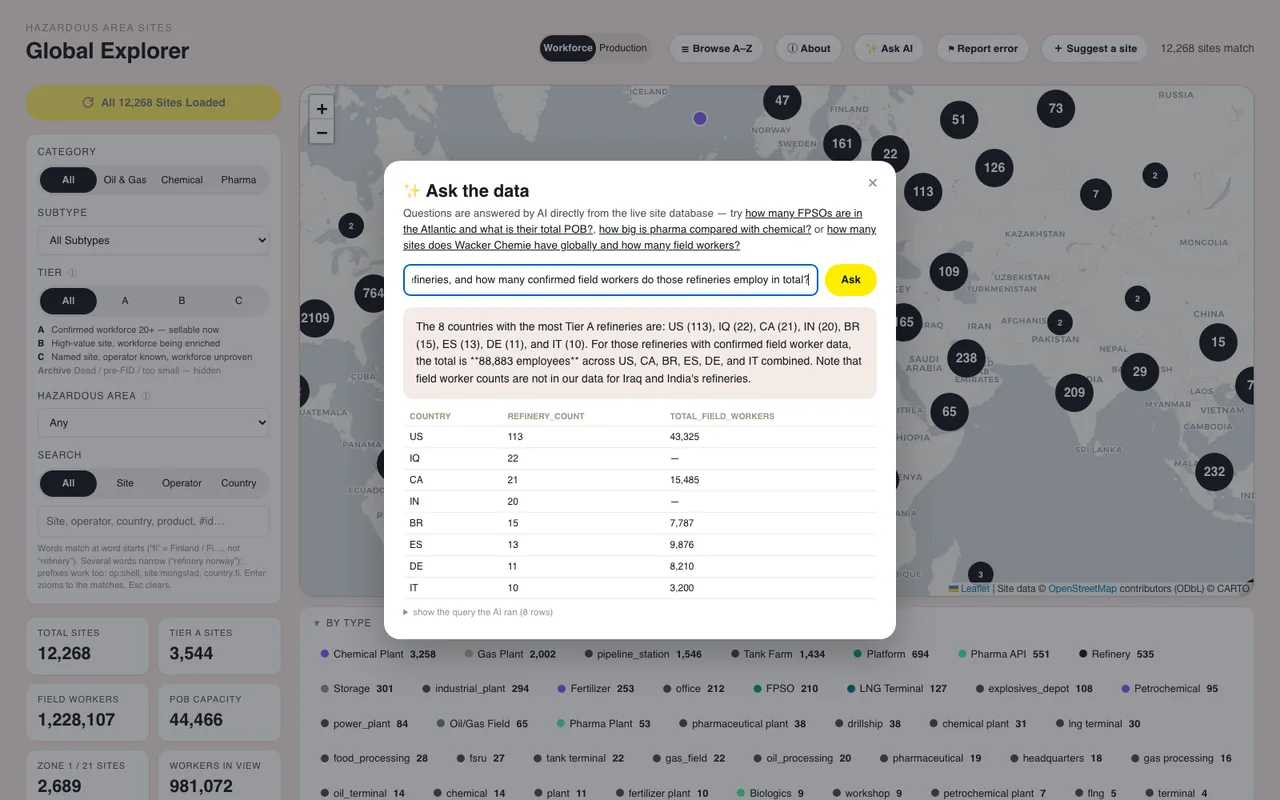
Ask a question. Get an answer and the query it ran.
Type a question in plain words. The explorer answers from the live database and shows its work so you can check it.
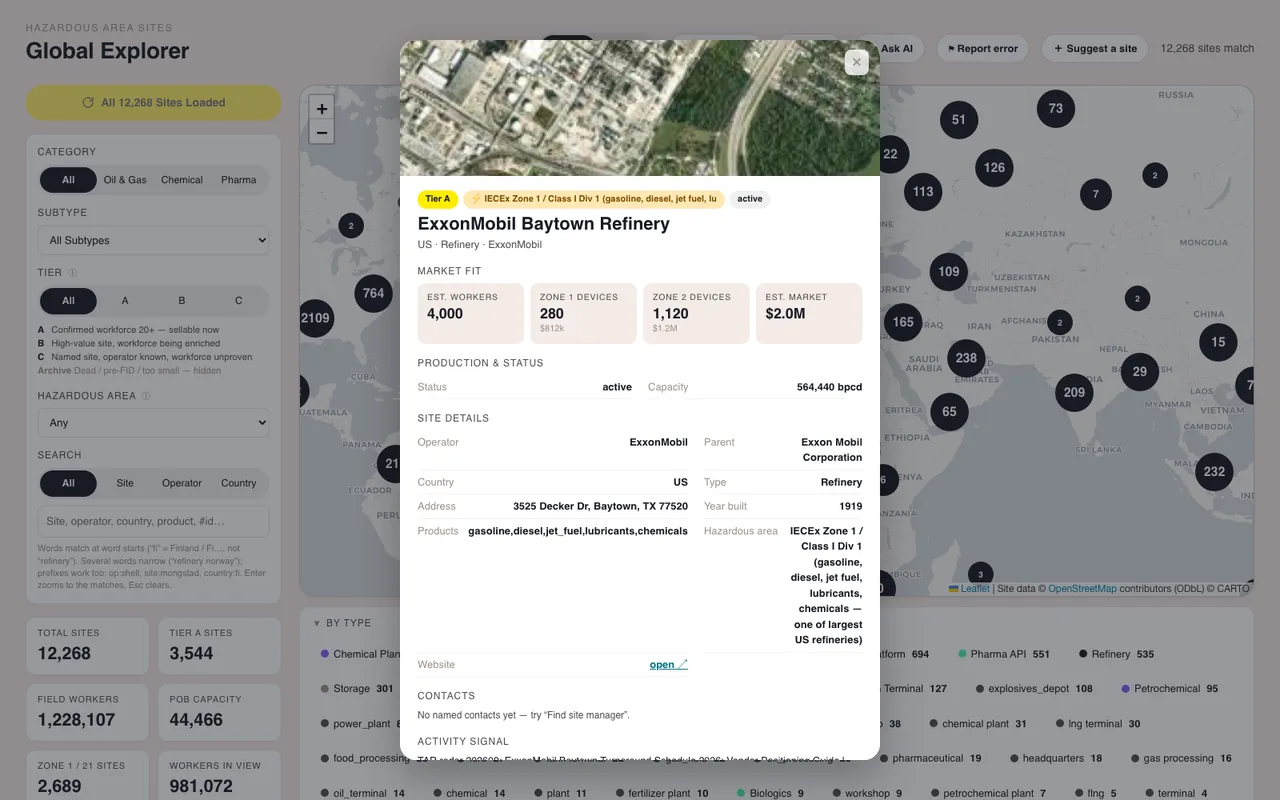
From FPSOs to pharma, one record shape.
Offshore, refining, gas and LNG, storage, chemicals, fertilizer, pharma. A refinery in Texas and an API plant in Switzerland compare like for like.
There is no public register for this. So we built one.
Start from the map
547,000 raw map features screened, merged and typed, so each physical site is one clean record.
Add the official registers
EU Seveso, UK COMAH, France's Géorisques, US EPA RMP and Norway's PRTR. Hazard classifications come from the regulators' own lists.
Research each site
1.5 million web searches across operator sites, annual reports, crew records and local press in a dozen languages. Each fact keeps its citation.
Check, then keep checking
Values pass validation before they go live. Anyone can report an error or suggest a site. A person reviews every submission.
Start free. Pay for depth.
Every plan includes the map. What changes is how much of each record you see, and whether you can take the data with you. Named contacts are not part of any plan.
Free
€0/mo
Name, operator, type and photo for every site.
No card required
Explorer
€90/mo
The full record: classification, workforce, status, sources. Ask questions in plain words.
Monthly, cancel any time
Export
€190/mo
Everything in Explorer, plus CSV export and pushing sites into your HubSpot.
12 months, billed yearly
Full Access
€290/mo
All fields, all sites, full export, CRM connector. Priority on corrections.
12 months, billed yearly
Channel partner? Territory links with named contacts are set up separately. Choose “Channel partner” in the form below.
Questions people ask before signing up
Does it include people's names and emails?
No. Named contacts are shared only with channel partners, under their own terms. Plans give you sites, operators, classifications and workforce figures.
What does the free plan actually show?
Name, operator, facility type, country and photo for every site on the map. Classification, workforce and sources are blurred until you move to Explorer.
How long does approval take?
A person approves each account, usually within one working day. Sign in with the Google account that matches the email you give us.
Where does the data come from, and can it be wrong?
Public map data, official registers, operator websites, annual reports and press, read and checked by AI with a citation kept for each fact. Yes, it can be wrong. Every record has a report button and a person reviews each report.
Can I cancel?
Explorer is monthly and stops when you cancel. Export and Full Access run for twelve months from the start date.
Who is this not for?
Anyone who needs contact lists or an outreach tool. This is a register of sites, not of people.
Tell us who you are. We set up your access.
A person approves each account, usually within a day. Free needs nothing more than this form. Sign in with the Google account that matches the email you give.